Photo: Dietmar Rabich, CC BY-SA 4.0, via Wikimedia Commons
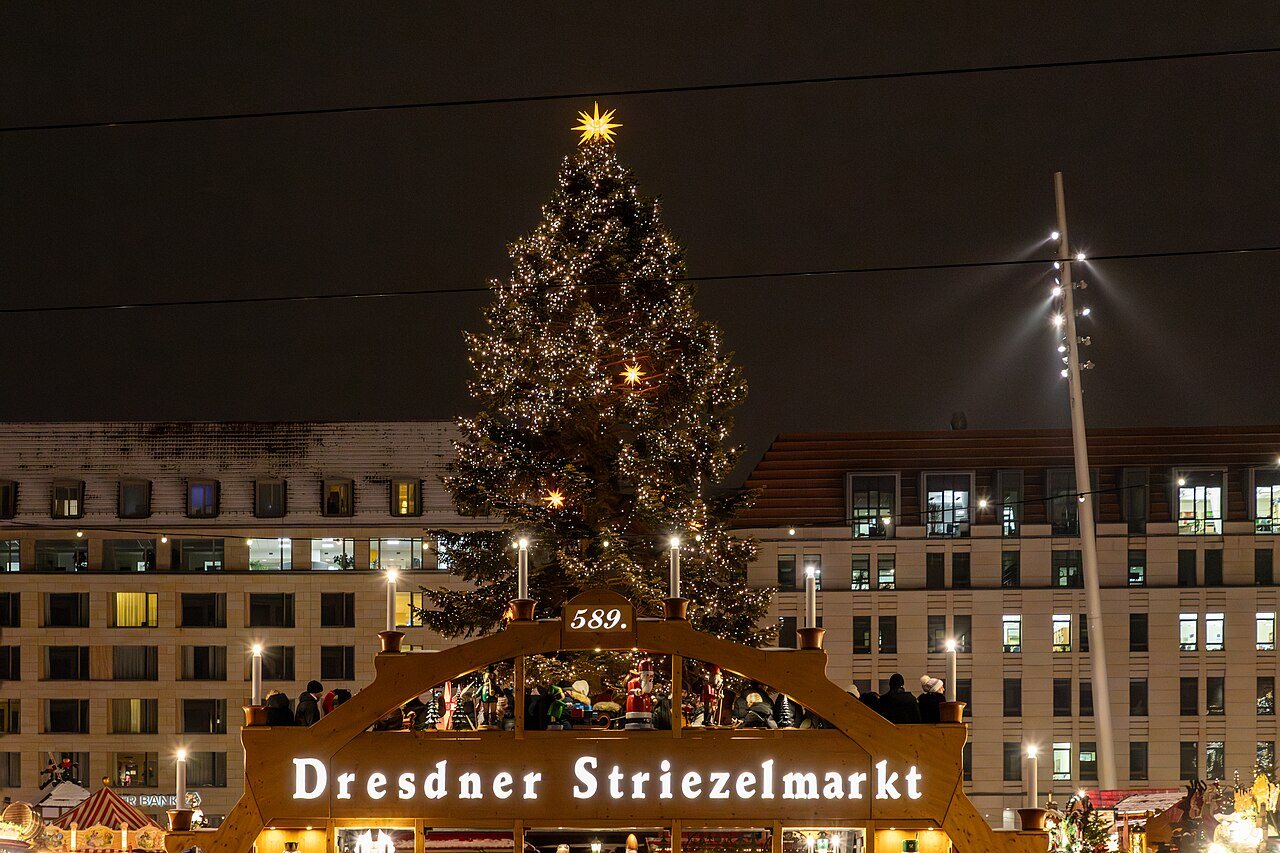
The entrance to Dresden's Striezelmarkt carries a number. In the photo above, taken in 2023, the wooden arch reads 589, because that was the 589th time the market had been held. Count forward and this winter's market is number 592. Not many Christmas markets can put a figure like that over the door.
The market sets up each year on the Altmarkt, the old market square in the center of Dresden, and it is one of the oldest Christmas markets in Germany with a documented start date. If you are planning a December trip to Saxony, it helps to know a little of what you are looking at, because almost everything on the square has a story.
A one-day meat market in 1434
The Striezelmarkt began in 1434 as a one-day market held just before Christmas, allowed under Elector Frederick II of Saxony. Its original purpose was practical: it gave townspeople a place to buy meat for their Christmas meal.
From that modest start it grew, slowly, into a full seasonal market. Over the centuries the stalls added toys, crafts and baked goods, and the single day stretched into the weeks of Advent.
Why it's called the Striezelmarkt
The name comes from "Striezel," an old local word for the loaf we now call stollen. Dresden is the home of Dresdner Christstollen, the heavy, buttery fruit bread dusted thickly in powdered sugar, and the market was named for it.
There's a nice piece of history baked into that loaf. In the Middle Ages, Advent was a fasting period, and butter was off limits, which left early stollen fairly plain. Saxon rulers asked the Pope to lift the ban, and in 1491 a papal letter, often called the "Butter Letter," allowed butter to be used. Stollen has been rich ever since, and I'm not complaining.
Dresden also holds a Stollen Festival each December, with an enormous stollen paraded through the old town and cut into pieces for visitors. If you want to see it, check the city's event calendar for the date, since it moves with Advent.
Prune chimney sweeps and carved figures
Walk the stalls and you'll keep seeing a small figure made from dried prunes threaded on sticks, usually with a paper top hat and a little ladder. That's the Pflaumentoffel, a traditional Dresden figure of a young chimney sweep. Chimney sweeps are considered lucky in Germany, and the Pflaumentoffel is sold as a good luck charm. It is edible in theory, though most people seem to keep theirs on a shelf.
A lot of the woodwork comes from the Erzgebirge, the Ore Mountains south of Dresden, a former mining region with a long tradition of carving. Look for nutcrackers, incense smokers shaped like little men, and Christmas pyramids, the tiered wooden carousels turned by the heat of candles. The market usually has a giant version as one of its centerpieces.
The candle arches
The arch in the photo is shaped like a Schwibbogen, a candle arch from the same Ore Mountains tradition. The story usually told is that miners, who spent the short winter days underground, set candles in arches in their windows to light the way home. You'll see small Schwibbögen glowing in Dresden windows all through December, and they make a good souvenir that's light enough to carry home.
The many-pointed stars
Once you notice them, the spiky paper and plastic stars are everywhere in Saxony in December: in shop windows, over doorways, and on top of Christmas trees (the one in the photo looks like one to me). These are Herrnhut stars, named for the small town of Herrnhut in eastern Saxony, home of the Moravian Church.
The usual account is that they began in the 1800s at the Moravian boarding schools there, where they were made in geometry lessons and hung up during Advent. The basic design has a core with dozens of points attached to it, and they still come from Herrnhut today. Stalls at the Striezelmarkt sell them flat-packed, which is useful if your suitcase is already full of stollen.
Tips for visiting
The Striezelmarkt usually opens in late November and runs until Christmas Eve, but the exact dates and hours change each year, so check the official Dresden tourism site before you book.
Weekday afternoons are calmer than weekend evenings, though the market looks its best after dark, when the arches and the tall tree on the square are lit. Mulled wine at German markets is commonly served in a mug with a deposit; keep it as a souvenir or return it for the deposit back.
Dresden has several other Christmas markets within walking distance, so if the Altmarkt is packed, it's easy to wander off to a quieter one and come back later. And do buy a stollen, even a small one. They keep well for weeks, which makes them one of the few market purchases that survive the trip home.
See more of us on GoogleAdd TrueVoyager as a preferred source and our stories can show up more often for you in Top Stories.