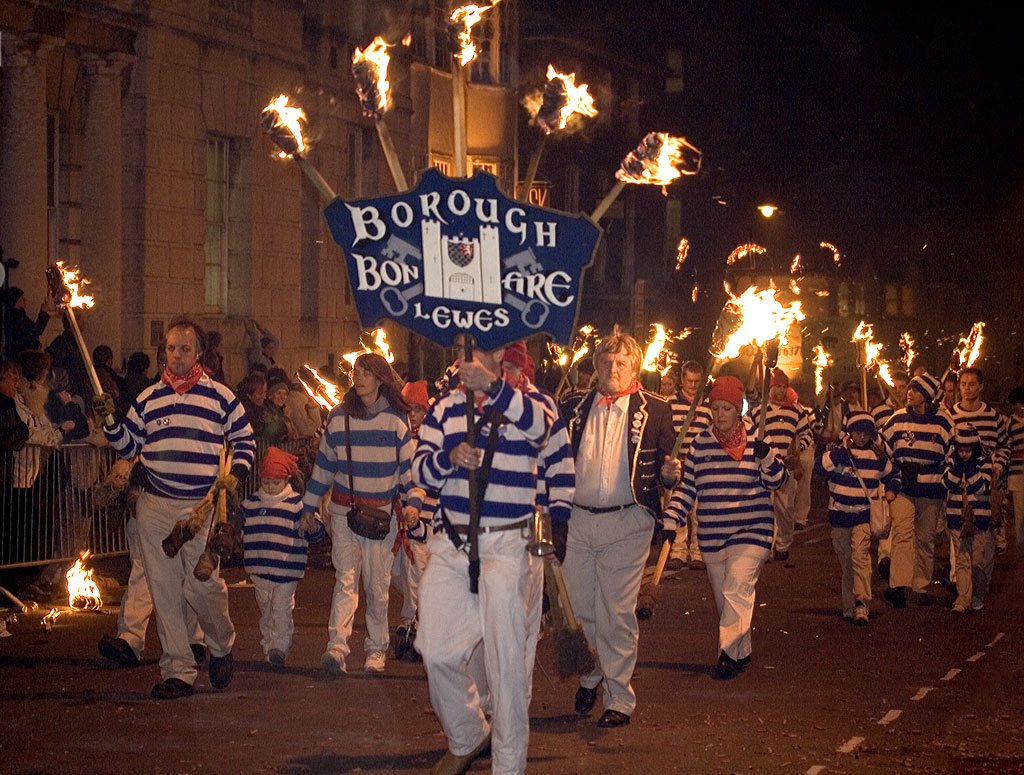
Photo: Lewes Borough Bonfire Society procession, CC BY-SA 2.0, via Wikimedia Commons
On the night of 5 November, the main street of Lewes fills with smoke. Thousands of people in costume march down the hill carrying flaming torches, some of them dragging burning tar barrels, while drums thump and bangers go off underfoot. Out on the edges of town, bonfires the size of houses wait to be lit.
Most of Britain marks Bonfire Night with a park fireworks display and a hot dog. Lewes, a county town in East Sussex with fewer than 20,000 residents, turns it into something closer to a carnival with a political edge, and it has been doing so, with pauses, for a very long time.
It is also one of the few big events I know of where the local council spends weeks asking outsiders not to come. Both of those facts are worth understanding before you plan a trip.
Two histories in one night
The obvious history is the national one. On 5 November 1605, Guy Fawkes was caught under the Houses of Parliament with barrels of gunpowder, part of a Catholic plot to blow up King James I. The failure of the plot was celebrated with bonfires, and the habit stuck across England.
Lewes adds a second, local layer. Between 1555 and 1557, during the reign of Mary I, seventeen Protestants were burned at the stake in the town for their faith. Lewes Bonfire Night remembers them too, and that memory shapes the whole evening. Seventeen burning crosses are carried in the procession, one for each martyr, and the processions also pause for wreaths to be laid at the town's war memorial.
The anti-Catholic tone of some old banners and slogans can be startling to visitors. The societies say the night is about commemoration and free speech rather than present-day hostility. You'll still see effigies of a long-dead pope burned alongside Guy Fawkes, which is the kind of thing that gets argued about every year (and probably should be).
The bonfire societies run everything
There is no single organiser. The night belongs to the town's bonfire societies, independent clubs with their own colours, costumes, routes and bonfire sites. Each has its own character, and members spend much of the year building floats, making torches and raising money.
Costume is a big part of it. Members march in historical dress, in striped smuggler jerseys, or in costumes representing different peoples and periods that the societies have adopted over generations, some of which have drawn criticism in recent years and been changed.
The processions wind through the town for hours, cross over each other and then head off to separate fire sites, where each society holds its own fireworks display.
The effigies everyone talks about
The part that makes the news is the effigies. Alongside the traditional Guy Fawkes, some societies build giant papier-mâché figures of current public figures, kept secret until the night and then blown up with fireworks at the fire sites. Politicians at home and abroad have regularly been given the treatment. Whatever you think of the target, the craftsmanship is serious work.
Why locals ask visitors to stay away
Lewes has narrow medieval streets and steep hills, and on Bonfire Night the crowds can be many times the town's population. That combination, plus open flames and fireworks, worries the emergency services every year.
In recent years the authorities have run a clear "don't travel" campaign. For 2025, Lewes District Council said trains would not stop at Lewes and several nearby stations from early evening until the next morning, major roads around the town were closed from late afternoon, and parking was restricted from midday. The council also noted that dozens of injuries are reported each year, many on the procession routes or caused by bangers and fireworks.
Expect something similar this year, but check the council and the rail operator for 2026 arrangements before making any plans. Do not assume you can drive in or catch a late train out.
If you still want to go
Plenty of visitors do make it, usually by staying overnight in Lewes or arriving early in the day while trains are still stopping, and leaving the next morning. Accommodation in town books up far in advance.
If you go, wear old clothes you don't mind getting singed or smoky, sturdy shoes and something warm. Keep a close eye on children, or think hard about whether a tightly packed street with flying sparks is the right place for them. Stay behind the barriers, follow the stewards, and keep well back from anyone carrying a torch or a barrel.
Ear protection is not a silly idea either. The bangers are loud and constant, and they are thrown in the street.
Other ways to see the tradition
Lewes is not the only Sussex town that does this. The county has a whole bonfire season, with other towns and villages holding their own processions on weekends through the autumn, often on a smaller and more manageable scale. If the idea appeals but the Lewes crowds don't, one of those is a gentler introduction.
And if you would rather see Lewes itself without the smoke, come back on a quiet weekend. The castle, the steep lanes down to the river and the old pubs are all still there, and you'll actually be able to walk down the high street.